Nighthawk’s Top Twelve Anime Films – Part One
It’s time for another one of these top ten (okay, so this one is a top 12 because I just couldn’t pop the two films left off the Top Ten as an honorable mention) lists. I’m a fan of such lists, I suppose, due to my religious watching of Late Night With David Letterman nightly in the early 1990s. The topic today is Anime feature films. I could do an entire blog on Anime if I didn’t limit myself. There was a bit of foreshadowing to this post between Mog and I in the comments section a few months back and at the time I didn’t actually intend to write it. I don’t think I’d seen ten anime films but since then I’ve been engrossing myself in what has become a phenomenon in the Western world just as it is here. I now see what draws people to these films over the repetitive crap Disney puts out monthly: beautiful art, memorable characters and fantastic stories.
One can trace the roots of anime to the experimentation of Japanese artists in the early 20th century. Influenced by varied styles of artists from Europe and the United States, Japanese artists would start to hone a style that would later be influencing others. The first known anime film is only three seconds long and shows a young sailor. Due to the exorbitant costs to make a live-action film in 1930s Japan, animation became a more costly format for filmmakers and artists to tell their stories. Whereas the realism factor in casting Japanese actors in the roles of Westerners was a problem, in animation people could be drawn, worlds created and stories could grow without any hindrance. In anime anything could be real. Then came a girl as white as the snow and seven dwarfs. Disney’s Snow White would be a great inspiration to many Japanese artists that would shape anime films. Though Japan had been using it’s own animation style for decades, the actual term Anime didn’t surface until the 1970s. The Japanese pronunciation “animeshon”, with a stress on the E to sound like A, was cut in half and the popular term for these films was born. Though popular in Japan, Anime did not gain a following in the West until the 1990s. What had been a small cult following exploded into thousands of kids collecting Pokemon cards and games. The door was open and hundreds of characters came rushing through it. Anime conventions would start to pop up in the US with attendees dressing up as their favorite characters in an imitation to the Japanese cosplay. Japanese artists were invited to speak of their creations and English dubbed versions of films that had been around for years in Japan debuted with American actors supplying the voices. In 2001, Hayao Miyazaki –one the geners most popular, if not the greatest, directors and anime visionaries—was honored with an Oscar for Best Animated Film.
The list below is a small fraction of the genre and from the handful of films I’ve watched in the last few months these stick out, to me, as favorites. I have a lot more digging to do and so should you. Next time you are at the video store and are reaching for the latest Disney direct-to-video sequel (Lady and the Tramp 80, for example), veer into the foreign section and grab yourself an anime, pop in the DVD and get lost in the fantasy.
And now, the list…
12. Lupin III: Castle of Cagliostro (Director: Hayao Miyazaki / Year of Release: 1979)
It’s Lupin, the world’s best thief, and his band of outlaws back for their second, and most popular, feature film. In Hayao Miyazaki’s feature film directorial debut, Lupin III and Co. find themselves in Europe after a big steal at a Casino in Monaco turns out to be bogus bills. Driving along a quiet country road our heroes witness a chase between a band of shadowy men and a pretty young girl. When an attempt to save the girl fails, Lupin finds himself in the possession of a mysterious ring that holds a secret from his past long forgotten. And so the adventure begins in what I consider to be a very Bond like production. We have action, ladies, gadgets and gizmos, explosions, fights and a villine who just doesn’t know how to get the job done. And then, of course, there’s Lupin, a character very much like the famed double-O agent. This film didn’t do very well upon initial release in Japan. Long time fans of the series (you might recall that Lupin got his break in manga) criticized the film for showcasing the title character as to light-hearted as opposed to his portrayal in the comic series. Light hearted hero or not, the Castle of Cagliostro is an animated adventure epic with comedy, action and romance. The entire package is just a lot of fun. I mean, the Bond flicks may not be masterworks of the medium but they are a blast to sit through and the same can be said for Lupin. Miyazaki hadn’t yet developed his style but elements are starting to bud. Castle of Cagliostro has the distinction of being the first anime film screened at Cannes. Not too shabby for a band of outlaws. 
11. Kiki’s Delivery Service (Director: Hayao Miyazaki / Year of Release: 1989)
You best get used to seeing Miyazaki on this list as he dominates it. This outing, I’d say, is his gift to the girls. No wolves and robotic castles in this tale of a young witch trying to make it on her own in a world of magic and wonder. Based on the book by Eiko Kadono, Miyazaki’s film is a charming film with a strong, willful female lead. When it came to compiling some anime to share with my daughter this was the first film that made the list. The animated work is usually not one to empower females so it was nice to see a change in this film. As is the custom to young witches, Kiki leaves home at the age of 13 accompanied only by her cat Jiji, set out into a world for a year where she must find within her special power and become a full witch. Settling in a small town by the ocean, Kiki becomes a sort of UPS with a broom delivering items all over town. When her powers disappear Kiki has to search within herself to regain them and become to witch she’s destined to be. This film would be picked up by Disney for US release and for that audience it was dubbed over with English that would cause some alterations to the Japanese version. In the English version Kiki is voiced by Kirsten Dunst and, in his final voice-acting roll, Phil Hartman. It was the highest earner in Japan in 1989 and the English version was a million seller helping to establish the growing popularity of the genre in the United States. And with popularity come the religious nuts. This film was actually protested by the Concerned Women for America, a conservative Christian group, over the usage of witchcraft. I weep for this world sometimes, folks. 
10. Ghost in the Shell (Director: Mamoru Oshii / Year of Release: 1995)
Created in manga by Masamune Shirow in 1989, is one of the first films to seamlessly blend computer and cell animation. It is also the first anime film to have a simultaneous release in Japan, the UK and the US. There’s a lot packed in to it’s hour and twenty-two minute running time. Without giving too much away, this futuristic flick follows a cyborg lead police force called Section 9 as it trails a master hacker dubbed The Puppet Master. Here, in 2929, the planet has become a collection of networks and computer systems. The Puppet Master has been infiltrating this network and it is up to Major Motoko Kusanagi to track him down. Kusanagi is our sexy, cyborg cop. She must have been designed for Maxim covers with those curves. When will we see an obese, female X-men? I digress. In this world almost everybody is enhanced by computer parts and herein lies one of the themes of the film: what does it mean to be human? What makes us who we are? Our heroine finds herself questioning her existence as she pursues the criminal who, himself, may be more then a simple sentient being hacking the system. In one scene we discover that “human” memories are what define humanity and that such memories may be implanted by computer programs fabricating your reality. Sound familiar? The cyborg police force are able to download information via hook-ups in the back of their necks. Wait…sound familiar? You’ve got your Matrix in my Ghost In The Shell! You’ve got your Ghost in The Shell in my Matrix!!! It appears as though a lot was “borrowed” from this film for the Matrix and both films explore similar themes pertaining to reality and what it is or isn’t. Both films also dabble into humans evolving through technology instead of it being the other way around and though Ghost In The Shell has the nudity and stylized violence one can expect in most anime underneath the art is a deep musing on our perception of self. 
9. Akira (Dicrector: Katsuhiro Otomo / Year of Release: 1988)
From TheSpectrum.net: “Originally released in 1988 and released in the United States in 1989, Akira hit with the force of an atomic punch to the gut. In telling the story of a futuristic Neo-Tokyo dominated by civil strife and violent teenage motorcycle gangs, Akira broke with most of the conventions associated with anime (at least in the west). Gone were the limited animation where nothing moves but the character's mouths, the syntho-pop soundtracks, and simplistic stories about cute kids fighting robots. Akira is an adult, intense science fiction thriller on par with such films as Blade Runner, the Road Warrior series, and even in some moments 2001: A Space Odyssey. It tells the story of a group of friends as they deal with the aftermath of one of them having a bizarre encounter with psychically gifted "young people" who are part of a government plan to harness immense power.” The film came from the 2, 182 page manga series and is considered to be what launched anime’s cult following in the 1990s. The film, exploring themes of political corruption and what can transpire when one finds themselves with an abundance of power, is part of the cyberpunk genre (as is Ghost in the Shell) of science fiction and it went on to break attendance records upon it’s release in Japan. The attention to detail in this film is evident within the first few minutes. Using 327 different colors (at the time the most ever in an animated film), 2,212 shots and at a cost of $10 million, the film is an epic of the animated art form and every moment is a marvel to watch. The plot is a complex one and I’m going to have to watch this one again as I’m sure much was missed. Upon first viewing you are just taken by the art on the screen and some of the story, as it was on me, can be lost in the beauty. Films like this one deserve repeat viewings anyway. 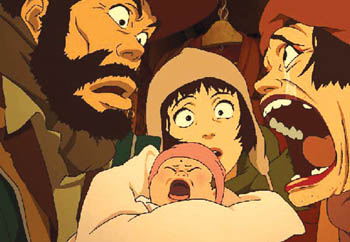
8. Tokyo Godfathers (Director: Satoshi Kon / Year of Release: 2003)
It’s Christmas Eve in Tokyo but there is not much celebrating amongst the city’s homeless. In the slums of the city a baby is thrown in the trash. The child is found by three of the homeless, including a transvestite named Hana. Hana wants to be a mother and urges the others to keep the child. When a key is found with the child, however, the three embark on a quest to find the parents. The IMDB lists this one as Rated PG-13 for thematic elements, violent images, language and some sexual material once again proving that anime isn’t Bambi. The story is based somewhat on the film 1948 John Ford flick Three Godfathers which has a similar plot. There are no Corleones in either film. You know, in case you were looking. 
7. Hadashi no Gen (Director: Mori Masaki / Year of Release: 1983)
A “cartoon” about the bombing of Hiroshima? One thing that sets anime apart from the singing animals and happy endings is the often unflinching realism found within the films. 1983’s Barefoot Gen is a prime example of this. This film is very similar to Grave of the Fireflies, another anime that would be released a few years later. So similar I have to wonder if Hadashi no Gen was an influence. Like Grave of the Fireflies, this is a stark portrayal of the aftermath of war. Often very depressing with graphic representation of the devastation of the bomb, you will find no singing rabbits in this film. This film is just dipped in so much sadness and dread. There are no pulled punches. You are pummeled with the reality of the bombing and what it did to the city of Hiroshima all seen through the eyes of a young boy shifted into becoming a man before his time. The bombing itself is about five minutes of animated horror and the rest of the film is a walk through hell. Though dark the film provides a moment of hope in a field of wheat pushing out of the soil said to not yield any crops for 75 years. This and moments of humor punctured in between the sorrow help us as views, as well as the characters, endure in a world so bleak. This film has to be applauded for not taking anything away from actualities. Children are vaporized, infants starve, skin hangs off burned zombie people searching for water and mounds of charred corpses tossed and discarded like yesterdays garbage are not film fabrications. Never has a “cartoon” been so real and so sad. It just puts your emotions through the thresher and I don’t think I can return to this one for awhile. In writing this I’m trying to shake some of the images and scenes from the film that are still gripping me. This is a history lesson showing us the power we now wield and the utter devastation and loss it can cause. Let us hope that the only time we ever need see such a nuclear nightmare again are in films such as this one:
TO BE CONTINUED
