The Nighthawk's Top Ten Japanese Monsters - Part 2

5. Mothra: The Wikipedia entry for Monthra classifies his species as a Divine Moth, which leads me to believe that he has a shrine somewhere around Japan where people leave him free cold coffees in a can. She, yes she, one of the one ladies of the great rubber beasts, debuted not in film but in a novel called The Luminous Fairies and Mothra. Man, that must have been a little depressing. Here you are a great winged month, DEVINE even, and you are getting second billing to Luminous Fairies. She would break onto the screen in 1961 in one of the best films in the genre. A scientific expedition finds a jungle of mutant plants and two tiny fairy-like women. After one of their crew attacks the island and kidnaps the women he brings them back to Tokyo where he profits off their singing abilities. Back on the island the natives are restless and call upon the God Mothra to avenge them. Mothra attacks, buildings fall and when the girls are released the call of the winged moth who simply flies back home. Kind of a downer, really, when you realize that there is no volcano involved. This film, less horror and more fantasy, deviated much from the norms of the genre. For one, the monster wasn’t destroyed at the climax and made the real enemy into a human. The film an underlying illusions to capitalism and Christianity, something most people don’t see coming in their giant moth movies. Mothra weighed about 22, 000 tons and could fly at Mach 3. Mothra has two forms, that of her larval form, then her adult form. When a larva she can spray silk to protect herself and can also latch herself onto her enemies. Her main ability is her psychic power. She can communicate with humans this way or use this power to defeat her enemies. She can create great winds with her wings and also, as a final line of defense, can spray yellow poisonous powder to asphyxiate her foe. She is generally followed around by those two little ferry women who speak for the moth in songs. The most famous of these songs was called Mothra’s Song and was written in the Malay language. Mothra has the greatest win-loss record against Godzilla. In a 1992 survey (those wacky Japanese monster survey takers) it was revealed that Mothra was extremely popular among women and the popularity of the character would create another series called Rebirth of Mothra. This was the first time a monster which gained prominence in the Godzilla series was granted it’s own franchise. So, the key to picking up Asian ladies is to tell them that you are a Mothra fan. My question here is in all of their grand technology the Japanese couldn’t invent, say, a giant fly swatter, bug zapper or canister of Moth-B-Gone? Mothra would make her final apperance to date in 2004’s Godzilla: Final Wars where she would help the green scaled one in a battle against Monster X. This would cost her her life. No word on what happened to the Smurf sized ferry chicks. Rest in peace, oh Divine Moth.
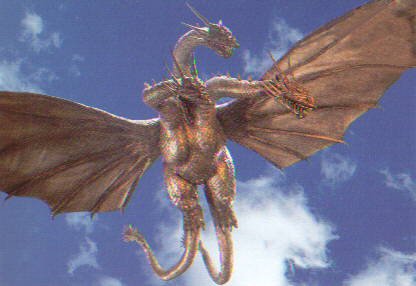
4. King Ghidorah: This three headed dragon may very well be Godzilla’s greatest opponent. He is one of the most powerful beasts in Japanese monster filmography and this has earned him the title King of Terror. At 140 meters in height and weighing 100,000 tons, this King first appeared in 1964’s Ghidorah, the Three-Headed Monster. The fact that the filmmakers choose to not include Godzilla’s name on the marquee showed how much bank they expected this new creature to bring in. The film sold about 4,320,000 tickets in Japan so one would consider that a success. He is a golden dragon with three heads and two tails. The cries from these heads, each a different variation, would be sound effect stock fodder for years to come. The design of Ghidorah seems to lend towards legendary Chinese dragons and is believed o have been used in the film as a metaphor for the fears held at the time by Japan of the Chinese satellite weapons program. In the film Ghidorah is found in a meteorite which crashes into Earth. You know the drill: monster attacks cities, death and destruction and Godzilla rides in to save the day and all is right in the monster filled world. The beast fires beams of energy from each mouth, is able to project lightening bolts from his wings, can create hurricanes, has the ability to drain the life force out of his enemies, can generate magnetic fields and can teleport small objects. When combined with his gold plated armour, there should be no doubt why he is called the King. King Ghidorah would return in several films thereafter and become Godzilla’s most frequent enemy. King Ghidorah would prove to be such a foe that Godzilla often needed aid to fight him. In one film it would take 10 monsters to beat him. In the first film it takes three monsters to overpower Ghidorah. In the first film, the creature is controlled by two stunt men fitted into the three piece costume. Puppeteers were also needed to control the creature making it one of the more elaborate designs to operate. Ghidorah’s fame extends out of the Godzilla films as he also appeared on television in the show Zone Fighter. He would also be used in the Monthra Trilogy, all showcasing his popularity with the fans. The creature was so popular that he was used in other forms. Kaiser Ghidorah, Death Ghidorah, Cretaceous Ghidorah and Mecha-Ghidorah have all been part of this characters lore and legacy.
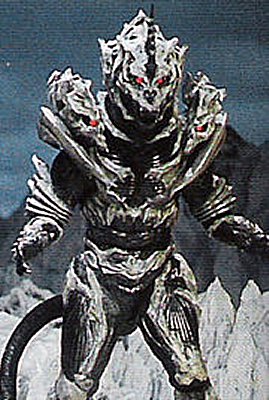
3. Monster X: 120 meters tall. 60,000 metric tons. Part dragon, part human, all one kick ass monster. Monster X has only appeared in one film, and it was a recent one, but that makes him no less a force then those monsters who have been around Japanese cinema screens for decades. Monster X really looks like he was created by Giger because the design of the creature, right down to the skeletal armor, is ripped out of the Alien franchise. The beast has skull-like shoulders and a forked tail aimed to impale. This dude is one of the ass kickingest creatures to grace a Japanese screen. His agility and strength are no match for the lumbering movement of Godzilla, the foe Monster X was created to destroy. X can fire gold beams out of his eyes as well as from the eyes on the shoulder skulls. To give you an idea of how much rubber ass Monster X can kick, he was able to fell Godzilla in a few seconds. His armor protects him from laser blasts. Monster X’s best line of defense comes in the ability to transform in to a form even more powerful then his regular appearance: Keizer Ghidorah. When in this form the two skulls grow to become two extra heads. Brought to earth by the Xilians, Monster X instantly sought out to destroy Godzilla. The two fought to a stalemate until Motra arrived to even the odds. Mothra would be killed by another Xilian sent creature called Gigan who also died in the conflict. Once again, it was just Monster X and Godzilla. The two battled in a matchup where none could get the upper hand. Finally the two crossed beams and were blown to the ground. Godzilla was the firs to stand but Monster X was undergoing his transformation into his Kaiser form. Now larger in size and with two extra heads, Monster X would attack an already vulnerable Godzilla, pummeling the great lizard as no other had before. But the country’s biggest box office draw will never die and Godzilla once again overcomes the odds, tears off the other two heads of Monster X before blowing him to tiny pieces above Tokyo.

2. Godzilla: What, the King of Monsters is #2? Hey this is my list, isn’t it, and we’ll find out why the great lizard is here and not in the number one spot when we find out who holds that coveted title. Regardless of my ranking, Godzilla is the most popular Japanese monster and has remained at the top of the mountain since his debut in the 1954 film Gojira. Like sumo wrestlers, Geisha and Super Mario, Godzilla is an icon of this country, an image people directly associate with the Japanese and is arguably their greatest film export. The film Gojira would usher in the genre of kaiju, a popular form of Japanese cinema to this day and certainly the most popular with Western audiences. He was born out of the nuclear attacks on Hiroshima and Nagasaki and represented the fears brought about by these events. He is 50 meters tall and 60,000 tons of lizard. His primary weapon is his atomic breath but he also uses a nuclear pulse, spiral fire ray and has the power to regenerate his energy. In the original film Godzilla was awoken from eons of slumber by a Hydrogen bomb test. He arose from the pacific and would attack Tokyo, something that reoccurred to an almost comic extent in this and other monster franchises. Over the years Godzilla would become more friendly and heroic beast, a move done to attract more children who had become interested in the creature. Godzilla has been in more monster films then any other Japanese film monster and he has fought and bested the bulk of the Japanese monsters. With over 5 decades of films under his belt, he ranks up there with Dracula as having the longest cinematic run. His name was created by conjoining the Japanese words for gorilla and whale. In the early stages he was not meant to be a lizard at all but a strange furry whale like creature, hence the name. Other reports state that he was to be a giant octopus. The first Godzilla suit weighed about 200 pounds. Haruo Nakajima would be the first to be bedecked in the legendary outfit. Nakajim was able to walk only 30 feet in the outfit, which can account for some of the editing in the film. Later costumes would be made for his body size. Cables in the costume were used to control the eyes and the mouth although these would later be replaced by batteries. It has been reported that cups of sweat could be taken from the custom at the end of the day’s shoot. The original film would not be seen in its correct form in America until recently when a DVD released restored the Japanese version. An Americanized version had been released prior starring Raymond Burr. Over the decades Godzilla has been reinvented 10 times. From video games, to films to comic books, Godzilla has been one marketable lizard for the Japanese. Although I can’t find any direct reference, it would seem extremely plausible to believe the creation of Godzilla was influenced by King Kong. Both films have similar themes. These two would cross paths in 1962. The ending of the film was mired in controversy when no clear winner was decided in the final climatic scene. Despite a press book of the time portraying Kong as the victor, people have debated the outcome for decades not wanting to believe the lizard could be bested. Godzilla was such a cinema icon that an American remake was released in 1998. This film was not well received by fans or critics for its bastardization of the original. The best possible showcase of how unpopular the American version had become would be found in the 2004 Japanese film Godzilla: Final Wars. In this film the original Godzilla obliterates the American version. The original Godzilla is actually a really good film and did no have the cheese factor found in later entrants in the series bogged down by annoying kids, convoluted plots and even stranger rubber monsters. Godzilla is the most referenced character in Japanese cinema having spawned of cartoon adaptations and numerous parodies. My favorite of these is a short cartoon from the late 60s depicting a confrontation between Bambi and Godzilla. His final appearance was in Final Wars where after all the evil was defeated he, as he has done before, walked back into the waters from which he came and vanished into the sunset. There is no doubt that Godzilla will rise again. He consistently brings in big box office bank and is as much a cultural property here in Japan as the temples in Kyoto. In 2004 Godzilla became the only giant lizard to get a star on the Hollywood Walk of Fame.

1.Gamera: Oh, Gamera, I never thought a giant spinning turtle could bring me so much joy but you, my friend, have and this is why you are here in the top spot. Sure, you are not as popular as Godzilla and, yes, most of your movies are sheer and total tripe but it was you Gamera that found yourself in more hilarious Mystery Science Theatre episodes then any other film star and for those laughs I hand you over the status of being the best. Gamera is 60 meters tall and is 120 tons of flying turtle who first spun onto the silver screen in 1965. Another rip-off of the Godzilla films, Gamera is wakened from yet another bomb. Could not better origins be drummed up for these creatures? At this point I’d take “Was created by a third grader out of mashed potatoes that were struck by lightening”. The first film would depict him as most Japanese monsters, evil and bent on destroying architecture, but something in this film would define the creature’s character in later showings. Gamera saves a child. Why, Gammy, why did you have to do it? The boy would believe Gamera was no so bad after and was actually his friend. This concept would continue in the sequels with far more annoying kids in shorts that looked as though they were painted on. The first film ends with Gamera being lured into a rocket and blasted into space. This was the final Japanese monster film to be shot in black and white. Gamera would return in many films with plots that mirrored the Godzilla films only with wackier creatures and goofier scenarios. The Turtle, now a Friend To All Children, would appear when evil creatures showed up, fight them, win and fly off leaving many fires, charred remains and destroyed buildings in his wake. That’s out Gamera! Gamera has the ability to fly by pulling his head into his shell and spinning about like a giant tortoise discus. Why has nobody ever tried to market Gamera Frisbees? His shell acts as a shield and he can spit fireballs at his enemies. Later version of the creature would have him firing off plasma balls. He has spikes on his elbows and can also heal himself by placing his body into an unconscious state. Because the creature feeds on fire, his greatest weakness is cold although that was abandoned in later films. Who the better monster was between Gamera and Godzilla has been debated with Godzilla obviously trumping the turtle in popularity. Godzilla films had bigger budgets, better creatures and better effects and Gamera floundered on the leavings. So the question is if Godzilla was so great why is he not included here as the best of the best. I’ve mentioned Gamera on this site before. I am loyal to the giant rubber monster that has entertained me the most. Godzilla may have had the cash, but Gamera had the laughs. The films in the Gamera series would gain popularity in the 1970s when they were often used on television as Saturday morning double features. Now, I cannot credit the Gamera films per say for making the creature my favorite. It was the crew of Mystery Science Theatre 3000 that first introduced the Gamera films to me. Five of the films were done, some of them doubled up upon when the show changed networks, and the result is some of the funniest comedic writing to ever grace television. The Gamera films used on the show sparked my interest in cheesy Japanese monster movies and those MST episodes are the ones I watch the most. The Gamera movies are overly stupid but they reach a point in their idiocy where they fall into the “so stupid it’s funny” category. These wacky films and the laughs they have brought places the giant turtle a notch above the giant lizard. If MST3K had done five Godzilla movies instead of two maybe he’d be here. Gamera’s last showing was in 2006, his 12th film. A updated version of the creature is reborn, befriends another small boy (thankfully the wardrobe department opted for pants) and would do battle with the monster Zedus before spinning way again. Like Godzilla, Gamera is a big draw and I am sure he will be back again shortly. I have looked all over Japan for a Gamera figure, one of the only personal gifts I wish to bring home, but he has not been easy to find. Godzilla’s everywhere, even a Rodan but no Gamera. The hunt continues. As this list comes to a close I’d like to leave you with The Gamera Song from the fine crew of Mystery Science Theatre 3000:
Gameraaaaa!
Gamera is really neat,
Gamera is filled with meat,
We've been eating Gameraaaaa!
Shells, teeth, eyes, flames, claws, breath, scales, fun!
Dr. Forrester is kind of a jerk,
And Frank is really dumb, too.
We have to take part in these lame experiments,
But do we complain?
No!
No!
Yes!
Huh?
So we "hi-keeba" all over the place,
And talk of a thousand wonderful days.
Everybody now
Gamera is really sweet,
He is filled with turtle meat,
Now we have Commercial Sign!
Happy trails from the land of giant rubber monsters. Until next time.
This post has been brought to you by:

